Case Study - Protecting Whanganui's Green Corridors

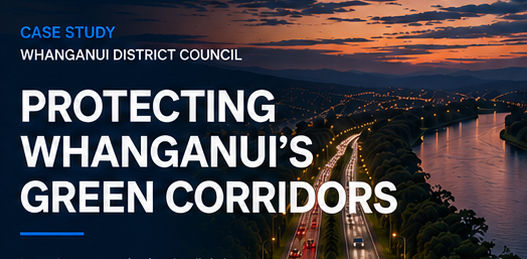
How AI-powered adaptive lighting is reducing light pollution and protecting New Zealand's natural environment.
Whanganui has a problem that most cities don't think about. Its roads need to be safe after dark but the environment surrounding them needs to stay dark.
Fitzherbert Drive runs through one of New Zealand's most ecologically sensitive green corridors, adjacent to a Dark Sky Reserve and home to native species that depend on natural darkness to feed, breed, and navigate.
Traditional streetlights, running at full brightness all night regardless of traffic, were working against that environment every single night.
Whanganui District Council wanted a better approach.
That's where PowerAID™ came in.
The Challenge: Light Where It Isn't Needed
Streetlights operating on fixed schedules don't distinguish between a busy Friday evening and a quiet Tuesday at 3am. They stay on. At full power. Regardless of what's actually happening on the road.

In most locations that's inefficient. In Whanganui, it was causing real harm:
Energy waste - higher consumption and unnecessary costs for the Council
Sky glow - increased artificial light affecting the night sky and the nearby Dark Sky Reserve
Ecological impact - light spill disrupting native wildlife, nocturnal insects, and natural ecosystem cycles
Many native species have evolved around natural darkness. When artificial light interrupts those cycles, the effects are felt across the whole ecosystem, not just at the roadside.
The Solution: PowerAID™ Intelligent Dimming
Felicity deployed PowerAID™ along Fitzherbert Drive, an AI-powered adaptive lighting system that responds to real-time traffic conditions rather than a fixed schedule.
The logic is straightforward:
When traffic intensity is high, lights stay bright
When traffic drops, lights dim proportionally
Roads remain safe - light on demand, where and when it's needed

No compromise on safety. No unnecessary output. Just intelligent infrastructure doing exactly what's needed.
The Results
Performance data from Fitzherbert Drive tells a clear story.
44.7% reduction in lighting output, measured PowerAID™ performance across 14 hours 30 minutes of burning time on 9 June 2026.
The lighting class distribution showed 82.41% of the night operating at reduced intensity, with full brightness applied only when traffic conditions required it.

Across four key outcomes:
🌌 Reduced Sky Glow - natural darkness restored, supporting the nearby Dark Sky Reserve
🌿 Protected Ecological Corridor - minimised light spill, reducing disruption to native wildlife and habitat
⚡ Improved Energy Efficiency - nearly half the lighting output eliminated, with direct savings for the Council
🛡️ Maintained Road Safety - adaptive dimming only when safe to do so, in line with road safety standards
What the Council Says
"It's great that we are working
with the Dark Sky Reserve.
I had experience with this in
the Wairarapa and it was a great
tourism benefit and a great initiative."
Mark Allingham,
Manager Transportation, Whanganui District Council
The framing matters. This isn't just a cost-saving exercise. It's a community choosing infrastructure that reflects its values, protecting a unique natural environment while keeping its roads safe and its people moving.
The Future of Lighting is Smarter, Not Brighter
Whanganui District Council is showing what's possible when infrastructure works with the environment rather than against it.
By deploying PowerAID™, they're not just reducing energy bills. They're protecting New Zealand's night skies, supporting biodiversity, and leading the way in sustainable public infrastructure.
The future of lighting isn't brighter. It is smarter.
👉 Learn more about PowerAID™ at felicitysi.com/poweraid


Comments